

The Reading Life You Used to Have and How to Get It Back
- Curated For You
- May 29
- 4 min read

Before all of this, you were a reader. Maybe a serious one. Maybe the kind who finished a novel in a weekend and started another on Monday. Maybe the kind who kept a stack on the nightstand and another on the floor and another, hopefully, in the bag. Then a baby happened. Then bedtime routines and pediatrician appointments and the kind of tired that makes the same paragraph blur three times before you give up and reach for the phone instead.
The reader didn't disappear. She just got buried under everything else you were asked to carry. But the longing is still there, isn't it? That very specific ache for a Saturday morning with a book and coffee that stays warm. For an hour where nobody needs anything from you and the only voice in your head is whichever one the author wrote. For the version of yourself who used to know what she was reading and what the next book in the stack was.
The good news is, she's not gone. She's just waiting for you to make room for her again. Here are four soft ways back in.
Build a Corner That Feels Unmistakably Yours
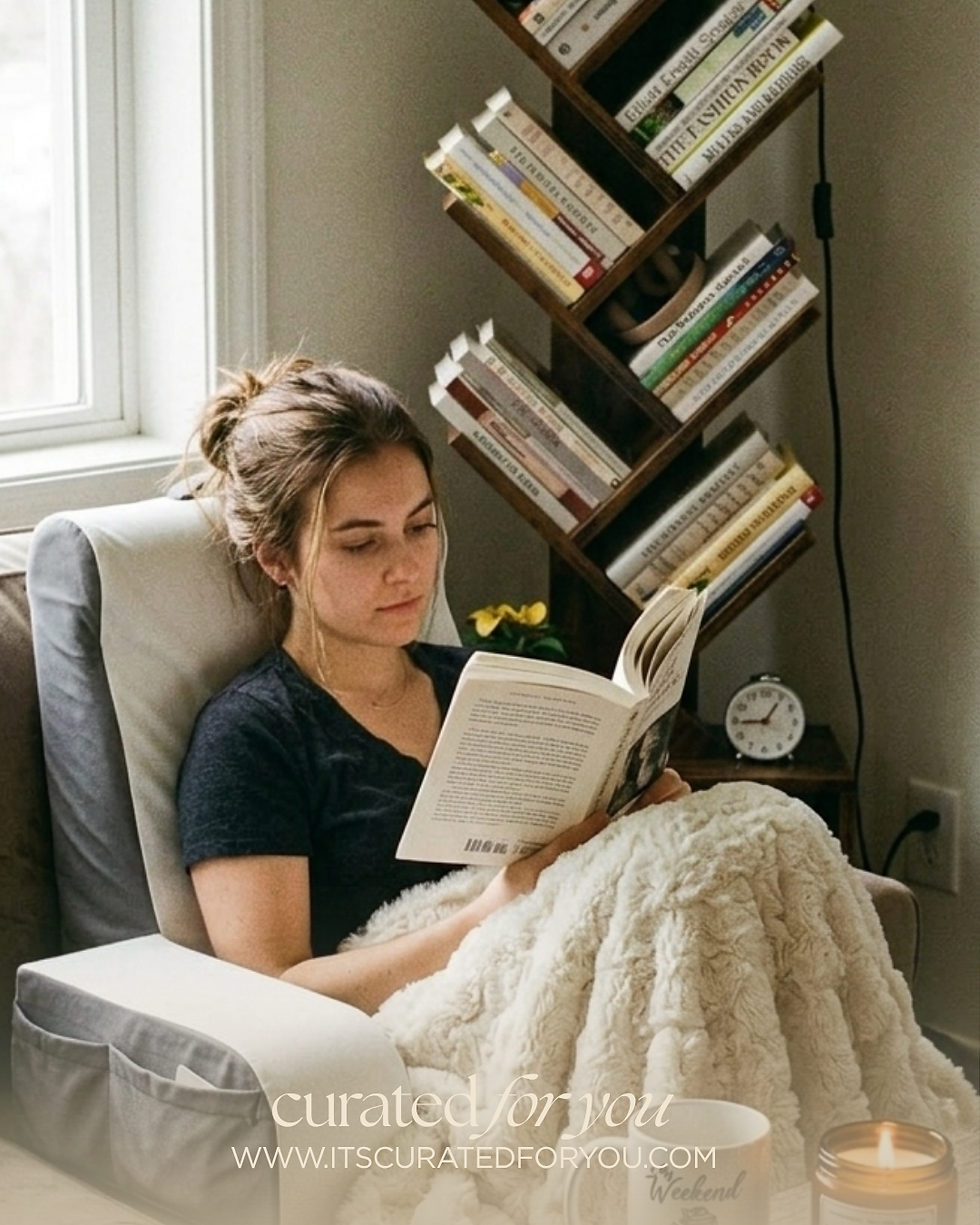
Your reading life needs a place to live. Not a perfect home library, not a Pinterest nook — just a corner of a room your brain learns to associate with quiet. A reading chair, or one end of the couch the kids haven't claimed yet. A soft throw within reach. A wedge pillow that supports your back the way the rest of the house rarely does. A lamp warm enough to feel like evening even at 7 a.m. A candle you only light when you're reading, so the smell becomes a kind of mental Pavlov bell — this is my time, this is the chair, this is the page. The corner doesn't have to be elaborate. It just has to be yours, and consistent enough that your brain stops asking what you should be doing instead the second you sit down in it.
Make the Book Yours by Writing in It

Somewhere along the way, we were taught that books were sacred objects to keep pristine. They're not. The best conversations you'll ever have with a book happen in the margins — a question scrawled beside a paragraph, a sentence underlined so hard it nearly tears the page, a sticky tab marking a passage you already know you'll come back to. For a mom whose brain has been holding everyone else's information for years, annotating is the radical act of having your own thoughts again, on a page, in your own handwriting. A fineliner that doesn't bleed, a small set of colored tabs, a stack of stickies — that's all it takes. The book becomes less of a thing you're consuming and more of a record of who you were exactly the day you read it. That's worth a few pencil marks.
Carry a Book the Way You Carry Snacks

The reading you actually get done as a mom rarely happens the way you imagined. It happens in fragments — the carpool line, the doctor's waiting room, the twenty minutes after one soccer practice ends and before the next one starts, the half hour you found because someone else fell asleep in the car seat and you can't move. The trick isn't waiting for an empty hour to magically appear. It's making sure a book is always within arm's reach so when the cracks open, you fall into the page instead of the phone. A book sleeve to keep the cover from getting trashed at the bottom of the bag. A clip-on light for the dark soccer-field hours. A bookmark that doesn't fall out the second you stand up. The fragments add up faster than you'd think — and a book read in stolen ten-minute pockets is still, fundamentally, a book read.
Keep a Record of the Reader Youre Becoming

There's something quietly grounding about writing down what you've read. Not because you owe anyone a list. Not because you're trying to hit a number. But because at the end of a year of motherhood — when so much of what you did was invisible, repetitive, swallowed by the day — having a list of the books you finished is one of the rare pieces of evidence that you were, all along, still becoming someone. A simple reading journal, a notebook with the title and a sentence about how the book made you feel, a bookmark that doubles as a tracker. That's all the system needs. Five years from now, the list will read like a small autobiography of who you were that year — what you were searching for, what you couldn't put down, what you needed to hear. The reading life isn't just about the books. It's about the woman they were keeping company.
Building a reading life back doesn't happen overnight. It happens slowly — one corner, one annotation, one book in the bag, one entry in the journal — until one day you realize you're in the middle of three books again, and the reader you used to be is no longer past tense. She's just home. Pick whichever one of these feels right for where you are today, and let the rest follow naturally. The pages are waiting, and so is she.
What was the last book you genuinely couldn't put down? Or the one sitting on your nightstand right now, waiting for you to find your way back to it? Tell us in the comments — we read every one.


Comments